
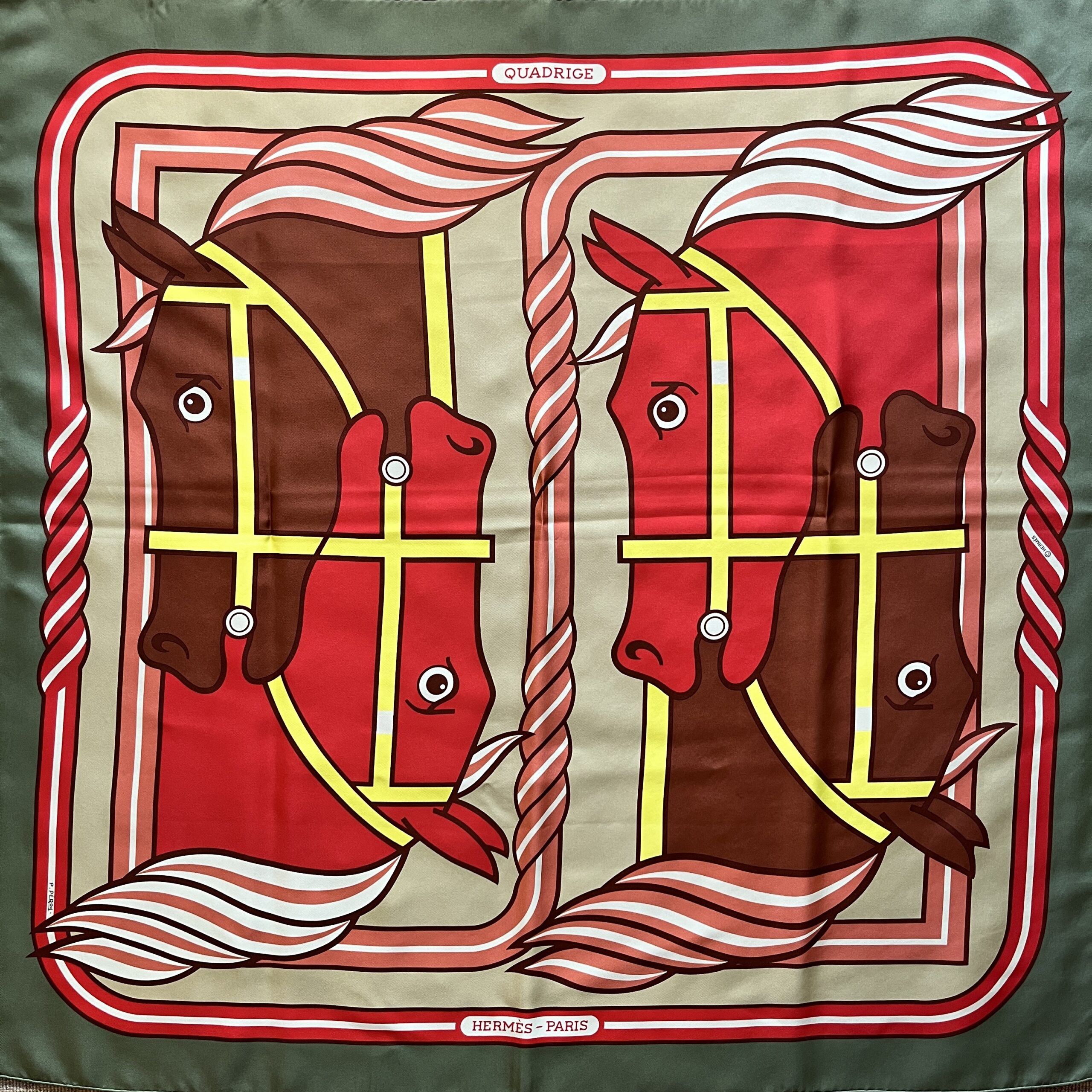



Hermes Quadrige II (Chariot) Appears Unworn
£299.00
In smart, elegant, dark khaki, this beautiful and popular Hermes scarf appears unworn, and comes complete with care tag. Condition 10/10.
Quadrige II is a highly coveted, modern variation of one of the fashion house’s most celebrated equestrian motifs. Originally designed by legendary artist Pierre Péron in 1973, the artwork translates a classic ancient four-horse racing chariot (a quadriga) into a striking, graphic puzzle of four intertwined horse heads.The “II” iteration updates this timeless artwork with clean, minimalist lines and distinctive two-tone or multi-colour blocking.
Hermes writes: the masterfully composed design presenting two interlacing horse heads and their intricate harnesses — an exercise in graphic virtuosity that interlocks the equestrian elements like the pieces of an elegant puzzle. The boldly graphic, linear composition, with its flowing manes rendered in graphic striped brushstrokes evokes the ancient quadriga — the four-horse racing chariot immortalised in the great sculptural friezes of the Grand Palais, the Brandenburg Gate, and the Parthenon — reinterpreted with the Maison’s signature wit and draughtsmanship.
The life of the famous French painter, sculptor, writer and jewelry designer Pierre Péron (5 October 1905 – 27 March 1988) was not easy. Born in the port city of Brest in the west of the Brittany Peninsula, Pierre studied painting at the Schools of Fine Arts in Brest and Nantes. In 1933 he received the position of a teacher of graphics at the Paris Academy of Arts, where he remained a professor until his return to Brest in 1965. Prior to the outbreak of World War II, Pierre successfully worked as a jewellery designer. In 1935, while in Paris, he joined the Seiz Breur (or Seven Brothers) movement of Breton artists, founded in 1923. An important focus of this movement was the revival of the original Kelt-Breton art. This led the artist to the Parisian company Kelt Maison Rivière, where he successfully created ornamental designs in 1936-1937.
During the German occupation, Peron was captured and spent two years in a concentration camp in Austria. After the war, Peron illustrated books, drew caricatures for magazines, wrote articles, worked as a decorator in theater and cinema, and was the curator of the Brest Maritime Museum.
In the early 1950s, Robert Dumas, who headed Hermès, invited Peron to create exclusive designs for silk scarves for his fashion house. This collaboration continued until the artist’s death in 1988.
1 in stock
Related products
-

Hermes La Marche du Zambeze MINT! In immaculate Original Box and Tissue with Sales Tag
£649.00 Add to cart -

Hermes Precious Paradise MINT! (almost) In original box and tissue, with Sales and Care tags
£949.00 Add to cart -

Hermes Scarf Toucans de Paradis MINT! In perfect Original Box, Tissue, Bolduc and Postage Box
£699.00 Add to cart -

Hermes Scarf Fleurs de Fuschia Almost Mint in Original Box and Tissue
£399.00 Add to cart