




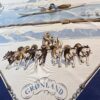


Beautiful Vintage Sought After Gronland
£275.00
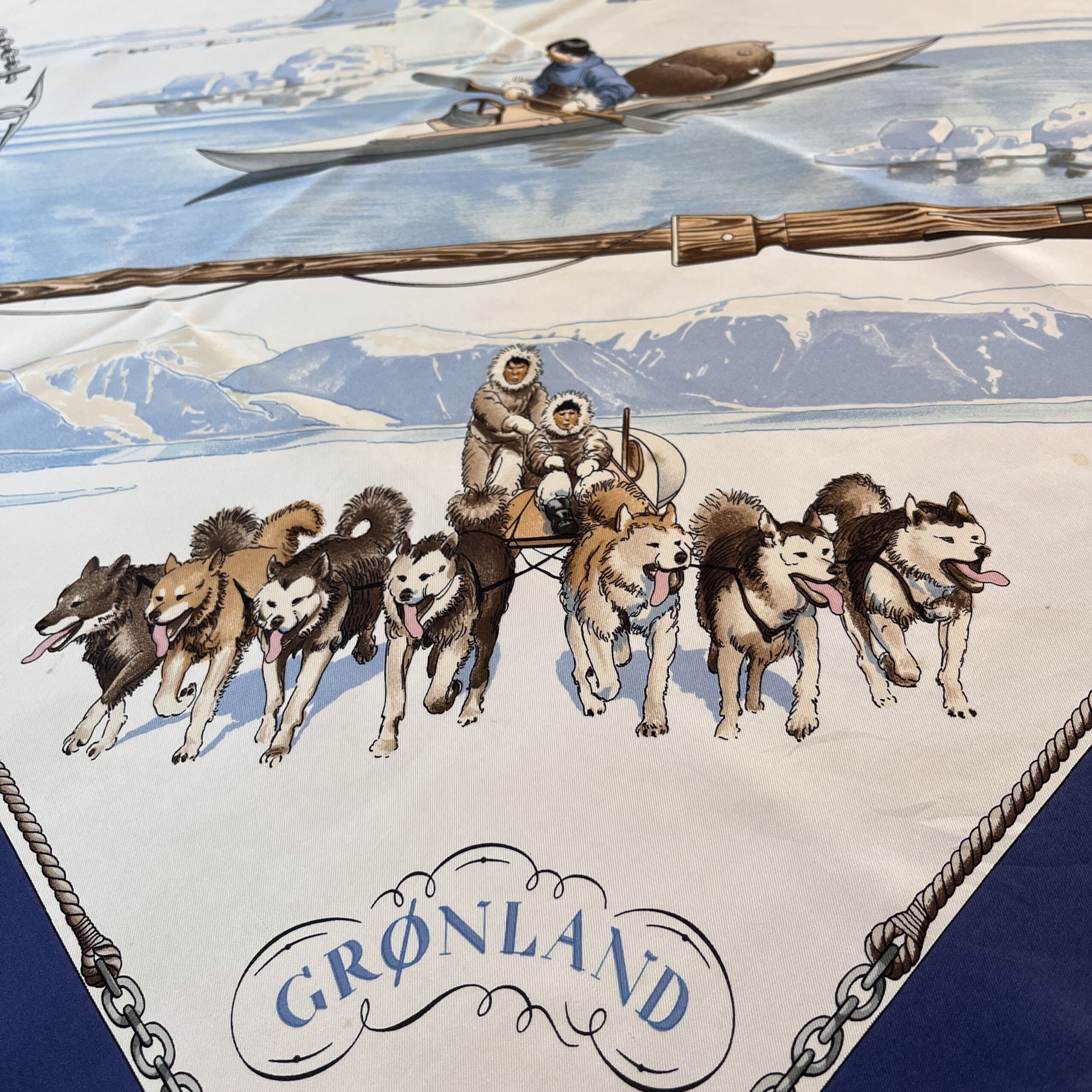
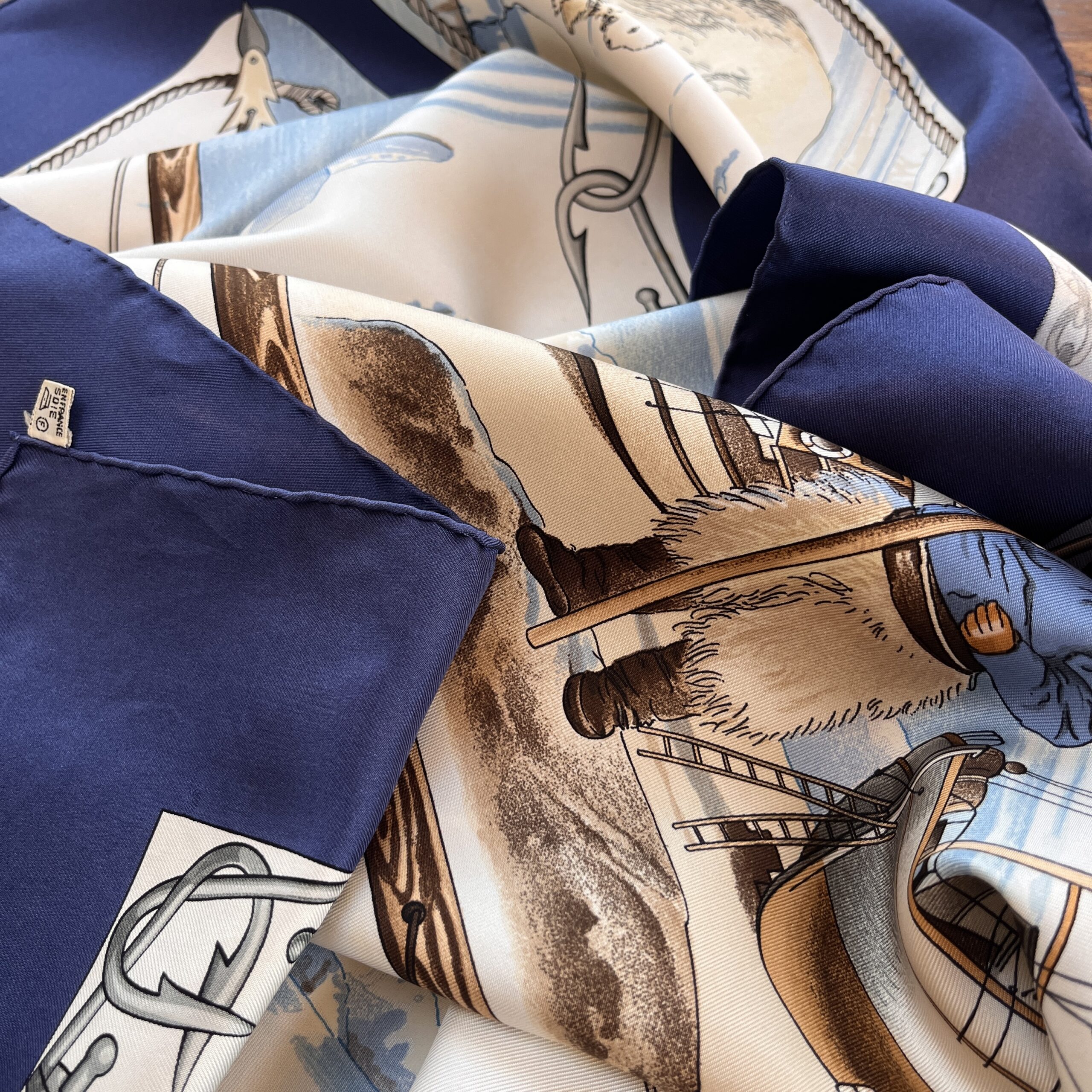
As ever, with a Ledoux, the detail of this Hermes scarf is quite extraordinary and beautiful! You can really see the floating ice in each exquisite individual vignette!
The scarf was originally designed in 1982. There is debate around the reissue dates, variously stated as 1992, 2000 and 2011; but judging by the shape of its care label, this one probably dates back to 1982. It has a couple of small marks on that wont show when worn, but retains its original brightness and clarity, and has the lovely soft drapeyness typical of a vintage scarf. Condition 8.5/10.
Hermes description:
“Crisp air, crunch of snow, the crystal clear sound of water, dogs panting, bears growling… Here, with heightened senses each moment becomes an eternity. Men live in close communion with nature whose beauty is surpassed only by its harshness, and animals are their companions, aides and resource. Clothed in sealkins, armed with harpoons, they hunt and fish in the vastness of this island of ice. Life could congeal as a flower freezes in snow, but instead it has grown in vigour. It survives and is stronger for doing so. Does the scarcity of resources in this ‘land of men’ make them wiser?”
Carre de Paris provides a biography of the legendary Philippe Ledoux, creator of ‘Gronland’:
“Like Hugo Grygkar, Philippe Ledoux, it can be argued, has left a huge impact on the Maison Hermès, in particular, the Hermès Carré. Some of the most collected Hermes carrés, such as the Napoléon, La Comédie Italienne and Cosmos for example, are among his creations. Other highly popular Ledoux scarves are Springs, Gronland, Harnais de Cour and La Promenade de Longchamps.
Born November 24th, 1903 in Sheffield, to French parents, his family returned to France in 1915. His artistic talents were recognised and encouraged early by his mother, Marie Villaret, who herself was an accomplished watercolorist and illustrator of children’s books. After some time in Rome, Philippe returned to Paris to study at the Académies de Peinture et de Dessin under the tutelage of Émile Renard and Joseph-Paul Alizard.
In his thirties, he returned to England and lived in London. He met and married, Madeleine Gautier in 1937 and they settled in Cormeilles-en-Vexin. Ledoux enlisted as a liaison officer with the British Army and was transferred to Dunkirk, while Madeleine stayed back at their home in France.
After the war, the couple lived in a village north of the French capital, far from the worldliness and conveniences of Paris, in spite of Madeleine having fallen seriously ill.
Philippe worked from home as a book illustrator and spent his free time at a local cafe sketching caricatures, a pastime he had picked up while living in London. His first illustrations were for the book, Naufrage de “La Méduse,” Voyage au Sénégal by Sander Rang (first published in 1946). Ledoux was also a contributor to the Bibliothèque Verte, a collection of children’s books.
Soon the style, sense of composition, accuracy and sensitivity of his drawings began to draw national attention. They did not go unnoticed by the Des Amis des Musée de la Marine (The Friends of French National Navy Museum), whose headquarters are still located in the Palais de Chaillot in Paris today. It wasn’t long before Ledoux became the illustrator of their publication, Neptunia. Philippe Ledoux has been credited with some 40 illustrations for the same publication, which he provided all free of charge.
Philippe Ledoux was enlisted by Robert Dumas in 1947 to design for the Maison Hermès. His amazing talents as an artist and illustrator can be enjoyed in the 90 carrés that he had created during his tenure at the design house.
His last two carrés, La Marine (a Rames) and Les Trois Mousquetaires, were finished by his nephew, Vladimir Rybaltchenko, after a motorcycle accident that took his life in 1975. Hermès issued a number of Ledoux’s carrés after his death.
Many of Ledoux’s creations have equestrian (Monsieur Dumas was particularly fond of Ledoux’s ability to draw horses) or naval themes with a soft spot for sailing. His love of ships and sailing may have been inspired by his grandfather, who was an accomplished sailor and who won several trophies for the Yacht Club of France, or possibly by vacations spent near the sea in Dinard, where his grandparents had a summer villa. Whatever inspired his love of the sea, Ledoux created many beautiful nautical themes such as: Musée, L’Océan or Vielle Marine to name but three.
Philippe Ledoux embodied both elegance and endearing crudeness. He possessed not only a great sense of humor and a generous spirit, he was an enormously gifted artist.
His art will live on, be it in a book or a magazine, or better yet, on a lovely vintage carré.”
Out of stock
Related products
-

Hermes Scarf Gronland in Pink
£299.00 Add to cart -

Hermes Scarf Au Coeur de la Vie (At the Heart of Life) MINT! Grail! In Original Box and Tissue
£599.00 Add to cart -

Hermes Le Regard de L’Arctique MINT! Rare and Sought After
£499.00 Add to cart -

Hermes Scarf Game Smiles In Third Millenary Very Rare
£199.00 Add to cart