

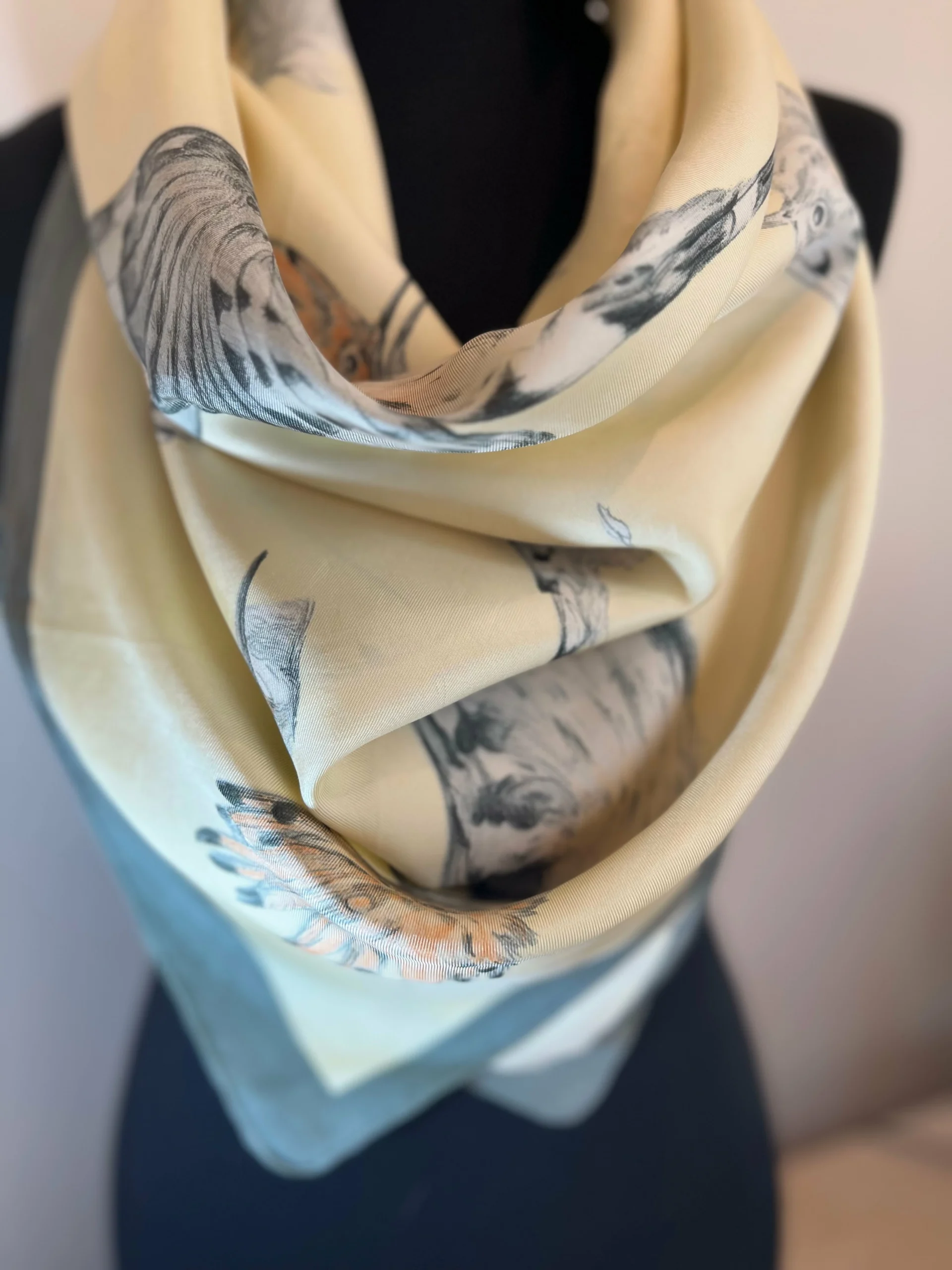



Extremely Rare and Highly Collectible, Cream and Dark Moss Green, ‘Les Huppes’ (Hoopoe Birds)
£599.00
We are thrilled to have found this – one of Hermes’ most sought after and collectible originals, Les Huppes was created by the iconic Xavier de Poret in 1958.
At a knockdown price, unbelievably this cream 70 year old scarf still shines! There are some faint colourwashes and a couple of marks on this just beautiful, precious, pretty intricate work of art. It’s made from the lighter-weight softer silk, typical of Hermes in the ’50s. The colours are slightly faded, but they were always muted, and the gorgeous delicate details and subtle colouring remain clear. Condition: 7/10.
The Hoopoe is an exotic looking bird that is the size of a Mistle Thrush. It has a pinkish-brown body, striking black and white wings, a black downcurved bill, and a pinkish-brown crest which it raises when excited. It does not breed in the UK, but as many as 100 Hoopoes can turn up in spring (mostly seen solo) as birds migrating north to Europe from Africa overshoot and land on the south coast of England.
Xavier de Poret (1894-1975) was a French artist who specialised in illustrations of animals – from deer, to horses, to pet dogs. His most expensive artwork recently sold for $67,351, for ‘Deer in the Moonlight’, sold at Thierry de Maigret in 2020.
A temporary exhibition, Parties de Campagne, in 2020, comprised 30 of Xavier de Poret’s sketches, studies, portraits, and hunting scenes, on loan from the Museum of Hunting and Nature in Paris. They demonstrate the artist’s understanding of the nuances in every stance, in every angle of the head, whether rabbit or roe deer. Xavier de Poret studied the nuances of each species.
Also included were his designs for Hermès scarves, starting in the 1950s, of game animals and hunting dogs, which are much favoured collectibles by many sporting ladies and/or their husbands’ paramours.
Son of a capitaine commandant of the 13th regiment of Hussars, Poret was raised in a château near Fontainebleau, 60 km southeast of Paris, surrounded by elegant gardens, fine horses, farm animals, aviaries full of exotic species, and the creatures of that noble forest.
Supposedly, Poret could draw animals before he could write. In fact, he never attended school, instead learning literature, art, and history from his mother who recognised his talent early, and brought in an instructor from l’École des Beaux-Arts.
By 1914, another animalier artist wrote to him, that he was as good as any of his generation. Drafted into the Dragoons during the Great War, Poret was severely wounded, and his older brother killed.
In 1918, he joined the Rallye Vallière hunt club, which pursued wild boar on horseback. His expanding knowledge of the chase led to his illustrating articles for publications such as le Saint-Hubert.
Starting in 1930, and for the next 30 years, he accompanied hunters in Switzerland to study chamois, eagles, ibex and marmots, and portrayed hunters with their trophies. The black chalk and charcoal drawing, Le Chasseur Clément Geinoz, shows the rugged hunter carrying out a prize chamois, slung over his shoulder.
He illustrated mountain-hunting titles such as Joseph-Louis Reichlen’s 1938, Au Pays du Chamois, Chasse et Montagne, which sold more than 2,000 copies, as well as books on snipe and capercaillie. The same year, he began portraying horses and their owners.
Described by his son as a charming, eccentric “slave to drawing,” who preferred oil lamps and sailboats, Poret married well, in 1920, to a lady with a title, Juliette d’Oncieur de la Batie. She inherited the comfortable Château de Plaisance in Riaz, Switzerland, where they settled in 1940, comfortably sitting out World War II in the peaceful paradise of the Alpine Gruyère region.
By the 1950s, the now “Le Comte Xavier de Poret” led a more mundane life, portraying the elite hunters and horses in the forest of Senlis. Soon the courts of Liechtenstein, Luxembourg, Belgium, and Austria beckoned. Perhaps the apotheosis of his career was being called to England in 1958 to paint Queen Elizabeth II on horseback, and Prince Charles and Princess Anne, each with their pony. He also painted the Belgian King Baudoin and Queen Fabiola.
Other de Pret scarves include: Les Biches (Does); Les Poulinières (Broodmares); Les Levriers (Greyhounds); and Les Chiens de Meute (Hunting Dogs), Les Renards (Foxes), Les Tourterelles (Doves), Les Teckels (Dachshunds), Les Ecureuils (Red Squirrels), and Les Mésanges (European Chickadees).
Out of stock
Related products
-

Hermes Scarf Tigre Du Bengale Unworn in Original Perfect Box and Tissue Collectors’ Favourite
£799.00 Add to cart -
Hermes ‘La Cle des Champs’ (The Key to the Countryside) in Jacquard Silk
£299.00 Add to cart -

Hermes Scarf Libres Comme L’Air (Free as the Air) Spotless Collectible
£299.00 Add to cart -

Hermes Scarf Parade en Fanfare – Joyous!
£449.00 Add to cart