


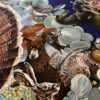
Feels Unworn, Utterly Beautiful “La Faune et Flore Du Texas – Texas Wildlife”
£549.00
Possibly the most coveted of all Hermes scarves. Just look at the extraordinary detail! You can almost hear the rustle of the bear, the deer, the hare, a horse, even an armadillo, amid the howl of a wolf, the twittering of the birds, and the gobbling of the dramatic centrepiece – a wild turkey! Around 100 native Texas animals and plants are represented, each a picture of its own, hours to be spent studying this scarf, yet there will always be more to see! And this scarf feels unworn!
“Faune et Flore Du Texas – Texas Wildlife” by postman Kermit Oliver, the only American artist ever to design for the Maison Hermes, was first issued in 1986, with Oliver’s signature and the Hermes copyright incorporated into the border. It was reissued in 1992 without the border, and the signature and copyright hidden in some leaves. Here we have the 1992 version, with care label intact. Condition 9.9/10.
The following article about this extraordinary man is taken from the Houston Chronicle, written by Joe Holley in 2014:
“A Well Kept Secret
In a tattered neighbourhood on what was once a busy commercial street in black East Waco sits an older white frame house behind tall shrubbery and a high brick wall. The house adjoins an abandoned movie theater. Parked in a vacant lot across the street is a tan ’59 Chevy Impala with trademark flattened tail fins.
The house is a couple of miles from where I grew up and a block up the street from Tony’s, where we got our barbecue on occasional Saturdays. The street I remember as lively and crowded years ago is today pocked with vacant, weedy lots and empty, decrepit buildings where homes and businesses used to be.
That’s of little consequence to the artist who’s lived for 30 years in the house behind the wall. Working out of a tiny studio inside, he produces strange, lushly illustrated worlds populated by people and animals realistically drawn but placed in surreal juxtaposition.
The artist is Kermit Oliver, a retired postal worker whose paintings hang in museums, on collectors’ walls and in galleries, where they command five-figure prices. They’re also reproduced on sumptuous silk scarves manufactured by Hermes, the renowned Parisian fashion house.
“He’s the only American artist that designs for them,” Mark Anderson, chairman of Baylor University’s Department of Art, told me recently. “He’s a well-kept secret.”
Although I had never heard of him, it’s debatable how well-kept the secret is. Soft-spoken and shy, Oliver is reclusive – “maybe even agoraphobic,” he told me, smiling, when we talked recently. Ironically, though, he’s become famously reclusive.
A slightly built man with a grey moustache and brushed-back hair, Oliver is 70 but looks maybe 20 years younger. He retired from the postal service last summer after 36 years sorting mail, first in Houston and then, for the next 30 years, in Waco.
Oliver’s ancestors on his father’s side were slaves brought from St. Louis in 1840 to work on ranches in the South Texas brush country. A self-described “Heinz 57 mix” of African-American, Irish and German, he grew up on a ranch near Refugio, where his father was a vaquero. Realizing at age 6 or 7 that he had a gift for drawing horses and cattle and sheep and goats rather than working them, he graduated from high school and enrolled at Texas Southern University in 1960. He took to heart the advice of one of his mentors at TSU, the legendary artist John Biggers, who told him to stay true to “your own message, your own language.”
Carl Jung’s book, “Symbols of Transformation,” exposed him to the liberating idea that all religions at their core share myths, symbols and basic themes. He’s drawn to that parallelism and seeks to express it through the surrealist images and Biblical allegories that populate his work. The cycle of birth, life, death and rebirth is a recurrent theme.
In the early years of his career he was an integral part of the Houston art scene. He taught at TSU and elsewhere and was the first African-American artist in Houston to be represented by a commercial gallery. In 2005, he was featured in a retrospective exhibition of his work at the Museum of Fine Arts.
He felt constricted by that life, so in 1984 he moved to Waco with his wife Katie, also an artist, to care for her ailing grandmother, who lived in the house where Katie grew up. He took the post office job, because, with three kids, he needed the steady income and the benefits. Always working the night shift, he’d sort mail from 11 to 7, come home and sleep for three hours or so and then get up and paint.
The Hermes connection began in 1980 when the company asked Lawrence Marcus, the executive vice president of Neiman Marcus, if he knew of an American painter who could design a scarf featuring a southwestern theme. Marcus knew Oliver’s work from Houston gallery showings. Hermes said oui, and Oliver has produced 17 original designs for the company.
“My art is just a natural expression of myself,” Oliver told me. “Everything is just happenstance.” What he means, as I understand it, is that his post office job allowed him to paint when and what he wanted to; he didn’t have to adhere to what the market dictated or what the art world prescribed.”
x
Out of stock
Related products
-
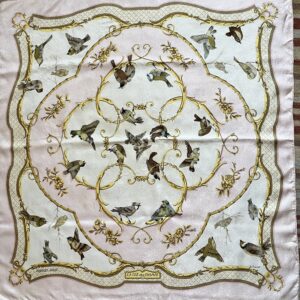
Hermes ‘La Cle des Champs’ (The Key to the Countryside) in Jacquard Silk
£299.00 Add to cart -

Hermes Fantasie Pittoresque MINT! In Original Box and Tissue
£1,199.00 Add to cart -

Hermes Bouquets Sellier (Bouquets of Horses’ Tack) Appears Unworn
£325.00 Add to cart -

Hermes La Marche du Zambeze MINT! In immaculate Original Box and Tissue with Sales Tag
£649.00 Add to cart