
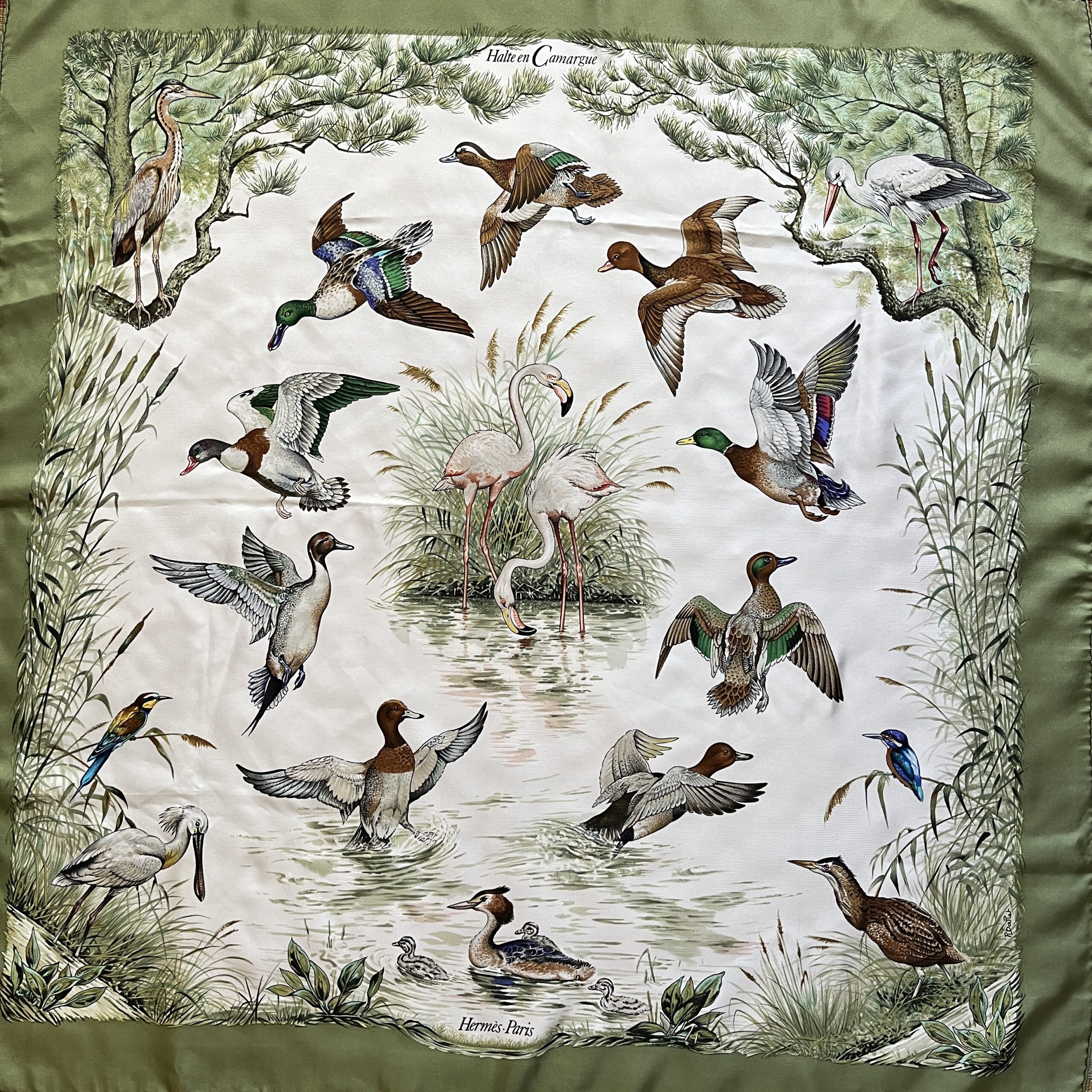


Hermes Halte en Camargue (Pause in the Camargue) Spotless (almost)
£325.00
A really beautiful design by one of our favourite Hermes artists, Robert Dallet. This scarf has been worn and loved, and it has that unique lovely soft drapey feel. It is more or less spotless, although our trusty microscope has managed to spot a couple of otherwise invisible teeny weeny marks. The colours remain vibrant and clear. No care label. Condition 9.75/10.
Robert Dallet specialises in animal designs, and this one features a quite lovely bird wildlife print, dating back to 1989, the first and only issue of this design, making the scarf nearly 40 years old!
The Camargue is a National Park and National Nature Reserve in southern France, probably most famous for its flamingos, white horses, and miniature black bulls.
The unique landscape of the Camargue is created by Europe’s largest river delta. The Rhone River rises in the Swiss Alps and flows from the Rhone glacier at Valais creating a massive cleft which separates the Alps from the Massif Central. At Arles in south-eastern France, the river divides into two arms, the Grand Rhone and the Petit Rhone. It is the emergence of these two arms of the Rhone into the Mediterranean Sea that creates the massive delta known as the Rhone Fan.
The Camargue National Park was created in 1972 and covers 85,000 hectares of land. The National Nature Reserve within the National Park consists of an area in excess of 13,000 hectares of which over 95% is protected from human use.
Although the temperature in the Camargue seldom drops below freezing it is famously windy, the most notorious of the winds being the mistral which blows from the north west. The area is also known for its ferocious Mediterranean storms which regularly feature thunder and lightning and torrential rain, and from April through to the end of November the area seethes with mosquitos.
Early morning is by far the best time to observe the numerous species of birds that visit or are resident in the Camargue. It is hardly surprising that the Camargue is so famous for its wading birds – so many of the iconic species can been seen here: Flamingos, curlews, Pied Avocets, Black-winged Stilts, Grey Herons, Purple Herons, Little Egrets, Avocets, Redshanks and Kentish Plovers, among many. Gulls and Terns include Herring Gull, Black-headed Gull and Sandwich Tern, Common Terns and Little Terns.
Other very rare birds can be seen (or heard) here, too, including the Night Heron, Bittern, Little Bittern and Squacco Heron. In recent years the Great White Heron has arrived in the Carmargue National Nature Reserve just as the Cattle Egret did before it.
And, at the right time of year, numerous ducks arrive in the Camargue. They are mainly passing through, but a few are resident: Mallard, Shelduck, Red-crested Pochard and Gadwall. Migratory species include the Tufted Duck, Shoveller, Pintail, Wigeon and Teal. Just about all of them are featured on this wonderful scarf.
The Rhone delta in the Camargue is the only nesting site in France for Flamingos. Of the 50 – 60,000 Flamingos that are found in the south of France in spring and summer only around 5 – 6.000 overwinter there. The vast majority migrate south to Africa and then make the return journey north in February and March the following year. They are extremely vulnerable: only half of those that arrive in the Camargue will breed and, even then, each pair only lays one egg. After a spectacular mating ritual which takes place in March and April the pairs build a cylindrical mud nest upon which the single egg is deposited. The icubation of the egg, which takes about a month, is shared by the parents, but once the baby hatches, it is moved to a ‘creche’ where the juveniles are managed en masse until the end of July when they are able to fly. The birds are not fully mature until they are 5 – 6 years old.
Robert Dallet loved the Camargue, and dedicated this wonderful design to it, calling it: “A Stay in Camargue”.
1 in stock
Related products
-

Hermes Photo Finish by Dimitri Rybaltchenko Feels Unworn
£399.00 Add to cart -

Hermes Scarf Au Coeur de la Vie (At the Heart of Life) MINT! Grail! In Original Box and Tissue
£599.00 Add to cart -

Hermes Scarf Libres Comme L’Air (Free as the Air) Spotless Collectible
£299.00 Add to cart -

Hermes Selle d’Apparat Marocaine (Ceremonial Maroccan Saddle)
£349.00 Add to cart