

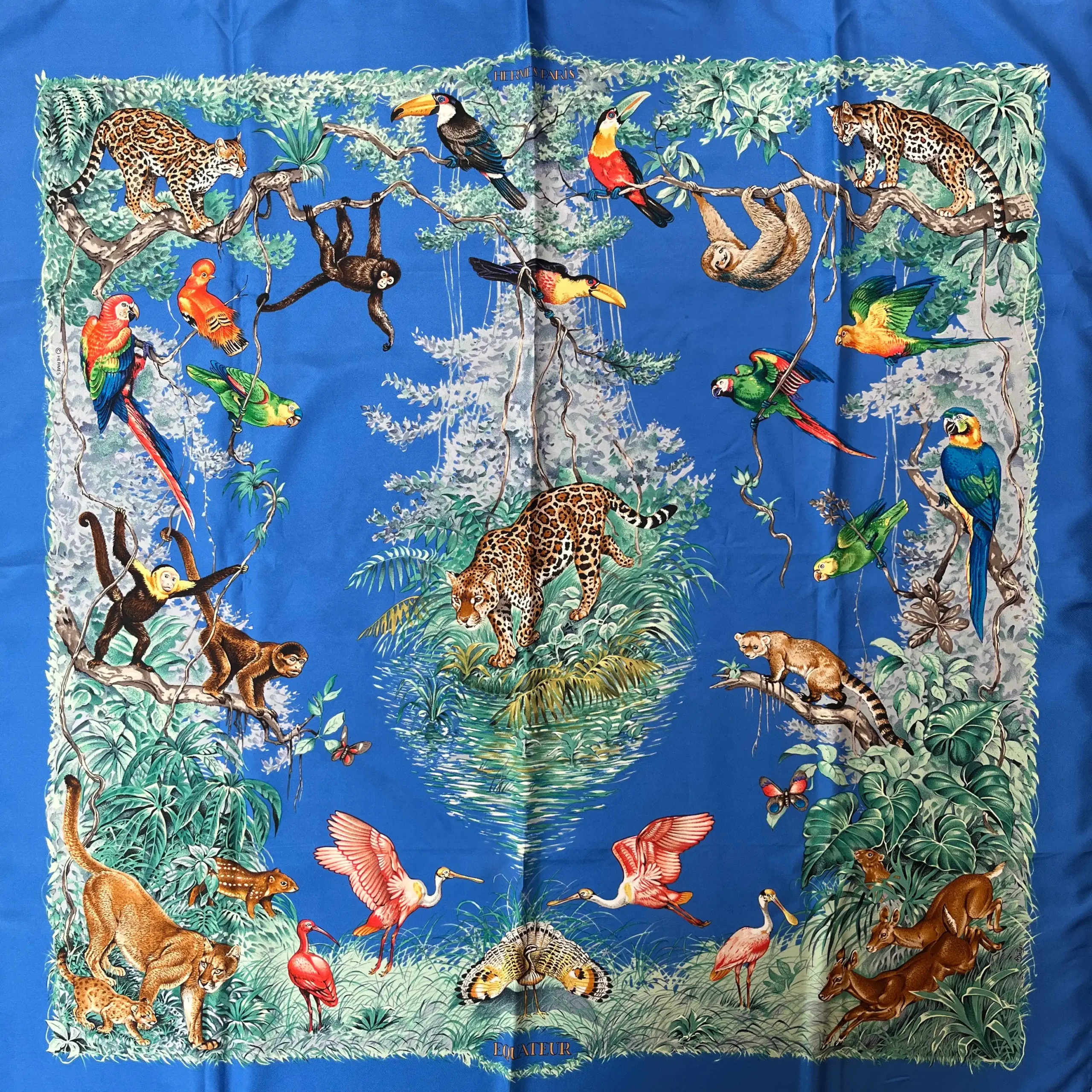



UnWorn, Deep Blue, ‘Equateur’ with Original Box, Tissue and Bolduc
£399.00
The most beautiful colourway available of this simply gorgeous, famous and popular Hermes scarf, in almost as new condition! It’s never been used, but there are a couple of the faintest marks on it and it has a couple of creases which aren’t its original folds, so we took the hard decision to take it to the cleaners. Condition 9.8/10.
Featuring innumerable animals of the equatorial zone of South America, ‘Equateur’ was designed by Robert Dallet in 1984, and re-issued in 1988. It was more recently reissued by the House of Hermes in a special soft velvety ‘wash’ fabric. Judging by its (slightly loose) long care label, this scarf is the 1988 version.
Robert Dallet has created close to twenty animal themed scarves for the Fashion House, including ‘Jungle Love’ and ‘The Cheetahs’, all of which have been in high demand.
Hermes describes the design thus:
“The equatorial zone of South America has remarkably diverse fauna and flora, providing a marvellous source of inspiration for the passionate naturalist Robert Dallet. Around a jaguar, the solitary big cat that prowls dense forests, a whole population of wild animals busies itself. The ocelot and the margay – small felines, sharp and keen – dominate the scene and frame a spider monkey, a sloth and toucans. Then comes the ballet of the macaws, parakeets and a cock-of-the-rock, followed by the white-headed capuchin, the woolly monkey and the ringtail. On the ground rest roseate spoonbills, a sunbittern with its wings spread, a scarlet ibis… A composition of multiple voices.”
Originally from Normandy, Robert Dallet was born in 1923, and, from a very young age, he was passionate about nature and drawing animals.
In 1952, he decided to make a career of it, leaving his home region for Paris on a quest for a publisher who would give him a first chance.
However, he had a difficult start. Making the most of his free time, he made frequent visits to the zoos and museums of Europe in order to refine his scientific knowledge. He studied the behaviour and anatomy of every animal, which he observed for hours on end, and drew hundreds of sketches in thick notebooks.
When he was offered his first few contracts, he also drew cartoons for various magazines. During this period, he created numerous books for children with the publishing house Lito in Paris.
He also worked for different nature magazines, and in 1960 he met Robert Wolff, better known by his nickname “Roby”, who was director of the journal ‘La vie des Bêtes’ in the 1960s. They would go on to collaborate for the next 16 years.
From 1966, combined with Roby’s texts, he illustrated a series of five volumes on the world’s fauna each year: Faune d’Afrique, Faune du Nouveau Monde, Faune d’Europe, Faune d’Asie and Faune d’Australie, all of which were published by Lito. Some had prefaces written by Professor Jean Dorst, a famous ornithologist who was director of the Museum of Natural History in Paris from 1975 to 1985, and one was prefaced by the Duke of Edinburgh. In 1969 M. Dallet won the Academy Grammont prize.
In 1972, he published several new works: Faune des Montagnes du Monde, Faune des Déserts d’Afrique and Faune des Déserts d’Amérique, also with Lito.
In 1974, with Roby continuing to write the accompanying texts, he published a book with Hachette, called ‘Parades et Combats du monde Animal’.
From 1975, he drew colour, and black and white, plates for the company Air Afrique, illustrating their guides to West Africa. For this he often travelled in Senegal’s national parks, exhibiting displayed at the Hotel Méridien in Dakar in 1978.
At the end of the 1970s, equipped with his profound understanding of animals, he decided to create a collection of more than 80 coloured plates. It was to be the first of its kind in the world, representing all the species and sub-species of felines. These works were displayed in an exhibition for the first time at the Museum of Natural History in Rouen in 1980.
In 1981, he published the book Les Animaux Prédateurs, again with Lito.
He participated in numerous projects with the WWF, for which he made posters and drew images for journals, as well as speaking at conferences at exhibitions dedicated to his work. He also made several television appearances.
In 1985, at the Museum of Natural History in Paris, directed by Professor Jean Dorst, he had the honour of presenting his collection to the public for the second time.
That year, following his participation in the Salon des Illustrateurs, he was approached by Jean-Louis Dumas, then president of Hermès, who asked him if he would design a scarf. ‘Kenya’ was to be his first, and the start of a collaboration that would last two decades. The most famous of his many other designs are Équateur, Jungle Love, La trêve de l’eau, Sichuan, Guépards, and Tendresse Féline.
Though he had started completely from scratch, he always remained incredibly humble and discreet.
Out of stock
Related products
-

Hermes Scarf Figure Artistique MINT! In perfect Box, Tissue and Balduc
£399.00 Add to cart -
Hermes ‘La Cle des Champs’ (The Key to the Countryside) in Jacquard Silk
£299.00 Add to cart -

Hermes Selle d’Apparat Marocaine (Ceremonial Maroccan Saddle)
£349.00 Add to cart -
Hermes Scarf Regina Queens Golden Jubilee Unworn, in Original Box and Tissue, Very Rare, and Very Sought After, Periwinkle Blue
£499.00 Add to cart